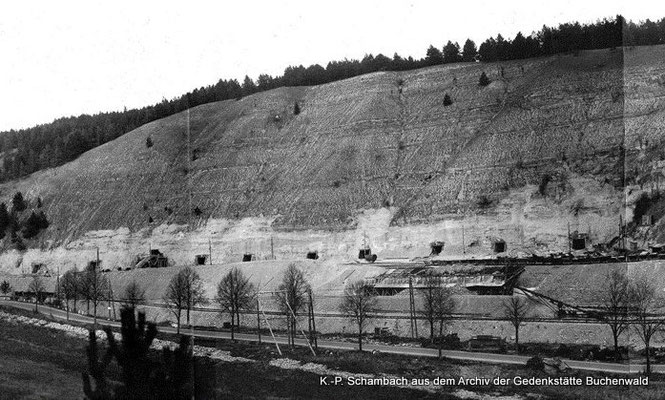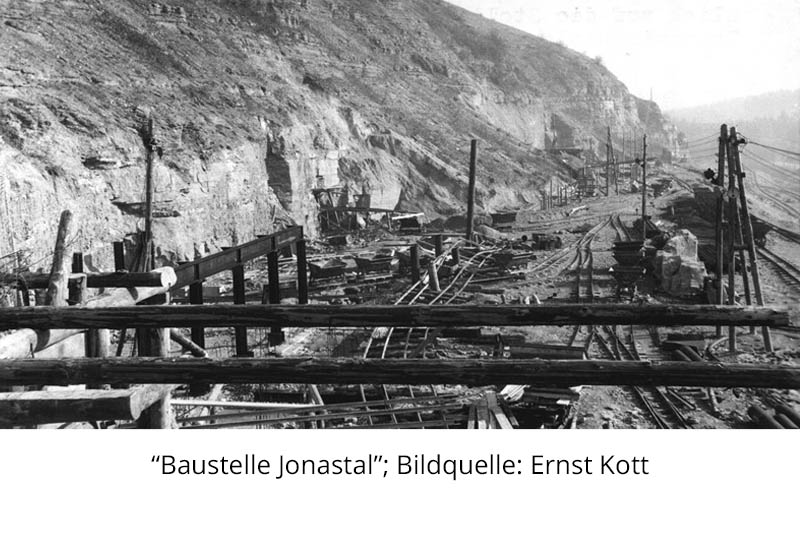
Between 1944 and 1945, the Jonastal, a remote valley in the Thuringian Forest near Arnstadt and Ohrdruf, was the site of one of the largest, but to this day most enigmatic construction projects of the National Socialist regime. At the heart of the project was the massive deployment of concentration camp prisoners, who had to drive underground tunnels into the mountain under the worst possible conditions. The valley thus became a core location of the S III subcamp complex.
In the summer of 1944, after increasing Allied bombing raids on German cities, the SS decided to relocate parts of the Reich government, military command and possibly also weapons production to underground facilities. Under the camouflage name “Sonderbauvorhaben III” (S III), work began on building an extensive underground bunker system in the Jonastal valley.
The aim was probably to build a bomb-proof seat of government or a “Führer headquarters”. Official documents about the exact purpose are still missing today. The scale of the project, the secrecy and the expense indicate a central plan – possibly even as a retreat for the Nazi leadership in the endgame of the war.
Work in the Jonastal began in the late summer of 1944. Within a few months, a construction site of gigantic proportions was created:
The work was carried out almost exclusively by concentration camp prisoners, who were herded into the valley every day from the newly established Buchenwald subcamps, in particular Espenfeld, Crawinkel and Ohrdruf. Guarded by the SS and organized by the Organisation Todt, they had to work at the risk of their lives – underground, with primitive tools, insufficient food and the constant threat of violence.
Many died of exhaustion, illness or as a result of mistreatment. The exact number of victims is not known, but it is estimated that several thousand people died in the vicinity of the S III project.
In April 1945, shortly before the end of the war, work came to an abrupt halt. The SS began clearing the camps. Prisoners who were left behind were murdered or died as a result of their imprisonment. The US Army reached the area on April 4, 1945 and found the construction site largely unfinished – but with clear traces of massive forced labor.
After the war, the tunnels were examined by Soviet troops. There has been much speculation about the alleged relocation of “wonder weapons”, nuclear projects or art treasures – but there is no evidence of this. The fact is that the Jonastal remains a symbol of the fanatical will of the Nazi leadership to save their power to the last – at the cost of tens of thousands of exploited human lives.
Today, the tunnels in the Jonastal are walled up or sealed. Some entrances are still visible, partly overgrown by plants or marked with warning signs. At first glance, the valley appears peaceful – but beneath the ground lies a testimony to the National Socialist will to annihilate.
For many years, the Jonastalverein – Geschichts- und Technologiegesellschaft Großraum Jonastal e.V. (GTGJ) has dedicated itself to the comprehensive documentation and historical reappraisal of the events in the Jonastal and the entire camp complex S III.
The results of this work are made accessible to the public in the documentation center in Arnstadt.
A memorial stone in Jonastal commemorates the victims of S III and the nameless dead who suffered and died here. Today, hiking trails and information boards point out the history. Nevertheless, the valley also remains a place of conspiracy myths, which often obscure the view of the true victims.
The Jonastal is exemplary of the inhuman ideology of the Nazi state: gigantism, secrecy, disregard for all human life. The memory of this place is both a warning and a responsibility – towards the past and for the future.
“Those who do not know the past are condemned to repeat it.”