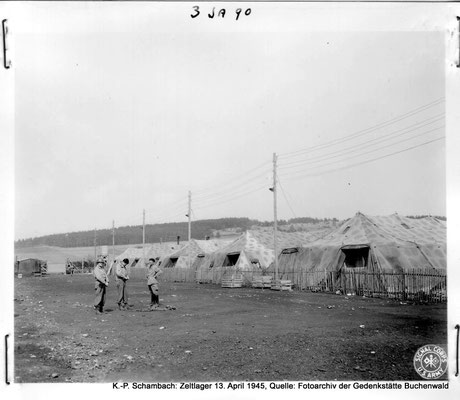
The Espenfeld satellite camp was one of the sites of the S III concentration camp complex, which was established in the region around Ohrdruf and the Jonastal between summer 1944 and spring 1945. Espenfeld was particularly characterized by its provisional, inhumane accommodation and the extremely harsh working conditions.
The camp was located on the southern edge of the small village of Espenfeld in the Thuringian Forest, not far from the railroad line and the country road between Arnstadt and Crawinkel. It was one of the
The prisoners slept on wet floors, on straw sacks or tarpaulins, which were often soaked. There was hardly any protection from the rain, wind and cold. In the fall and winter of 1944/45, this meant a life-threatening strain for weakened people.
Several hundred prisoners were housed in the Espenfeld camp – mainly men from France, Poland, the Soviet Union, Hungary and other countries occupied by Germany. Many were political prisoners or deported civilians. The food was completely inadequate, there were hardly any sanitary facilities, no medical care and constant harassment by the SS guards.
The camp was under the supervision of SS personnel and was completely isolated from the rest of village life. Nevertheless, the residents of Espenfeld were indirectly aware of the camp – for example through transports, gunshots or occasional sightings of the emaciated prisoners.
The prisoners from Espenfeld were sent in columns to the construction sites in Jonastal every day. Under the supervision of the SS and the
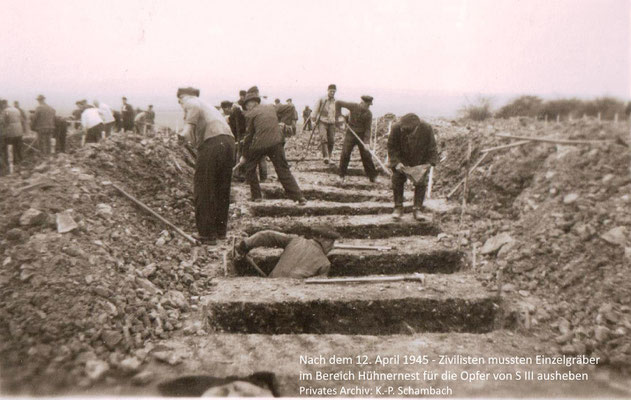
Returning to the camp meant no rest: hunger, illness, exhaustion and violence claimed victims every day. The exact number of dead from Espenfeld is still not known today – many were buried anonymously or buried in mass graves.
With the advance of the US army in spring 1945, the National Socialists began to evacuate the Espenfeld camp. The surviving prisoners were sent on so-called death marches to Buchenwald or Dachau – many did not survive this last march.
After the end of the war, the camp site was razed to the ground. Today,
The memory of Espenfeld lives on today primarily through research, memorial initiatives and digital reappraisal. In cooperation with local archives, the Buchenwald Memorial and the Jonastal Memorial Association, knowledge about the camp has been made accessible again. On the outskirts of Espenfeld, not far from the former camp site, a simple memorial made of natural stone commemorates the victims of the Buchenwald concentration camp satellite camp there.
Espenfeld is an example of the often invisible places of terror – camps that only existed for a short time, are barely documented, but nevertheless cost countless people their lives. Their stories deserve to be told and remembered.
“Remembering means acting.” The commemoration of Espenfeld is not only intended to remember the suffering of the victims, but also to call for vigilance against all forms of inhumanity and exclusion.