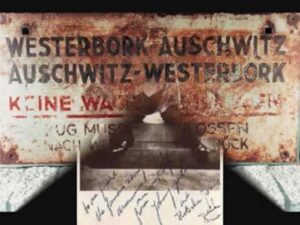
Petro Mishchuk was born on July 10, 1926 in Kysylyn in the former Soviet Union, in what is now western Ukraine. As a teenager, he was caught up in the mills of Nazi occupation policy: in 1942, at the age of just 14, he was arrested in the forest as a suspected partisan. Deportation followed – first to a ghetto, later to Auschwitz.
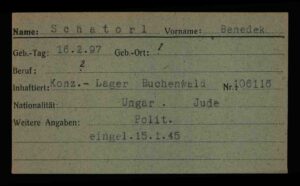
From there, he was deported to various camps, including Berlin and near Magdeburg. On March 9, 1944, he was sent to Buchenwald concentration camp as a forced laborer. There he was given the prisoner number 105105 and was soon transferred to the notorious Ohrdruf satellite camp (S III).
In Ohrdruf, Petro Mischtschuk was subjected to unimaginable suffering. He was forced to do forced labor – for example, laying miles of barbed wire or hauling heavy boulders to build tunnels in the Jonastal valley. His daily diet consisted of spinach water and turnips. He had to stack dead fellow prisoners in barracks and witnessed how SS men broke gold teeth out of the mouths of the deceased.
At the beginning of April 1945, Petro and thousands of other prisoners were sent on a so-called death march back to Buchenwald and on towards Sachsenhausen. Many died on the way from hunger, cold or being shot. Petro only survived by chance and necessity – thanks to collected beechnuts and the compassion of individual villagers.
He was liberated shortly before the end of the war. Originally, the prisoners were to be drowned in the sea on the coast – but American troops intervened in time. After his liberation, Petro Mishchuk returned to his homeland on foot.
He is still active as a contemporary witness today. In Ukraine and Thuringia, particularly in the Gotha and Arnstadt areas, he talks about what happened. He worked with memorial sites and the Jonastal Association and made his experiences available to film projects and school classes.
Petro Mischtschuk is one of the last known survivors of the Ohrdruf camp. His voice is a powerful testimony to the suffering of countless victims – and an appeal to future generations to stand up for truth, humanity and remembrance.
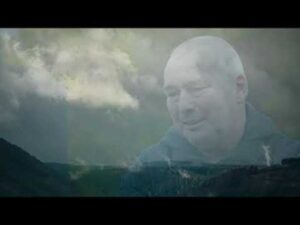
Video interview: Petro Mishchuk as a contemporary witness
- Title: Contemporary witness interview with Petro Mischtschuk – memories of the Ohrdruf camp
- Length: 35 minutes
- Languages: Ukrainian with German subtitles
- Content: Mishchuk gives a vivid account of his deportation, everyday life in the Ohrdruf camp, the death marches and his liberation.
- Published by: Stiftung Schloss Friedenstein Gotha / Thuringian State Agency for Civic Education
- YouTube link: https://www.youtube.com/watch?v=9vurKLiJnyA