
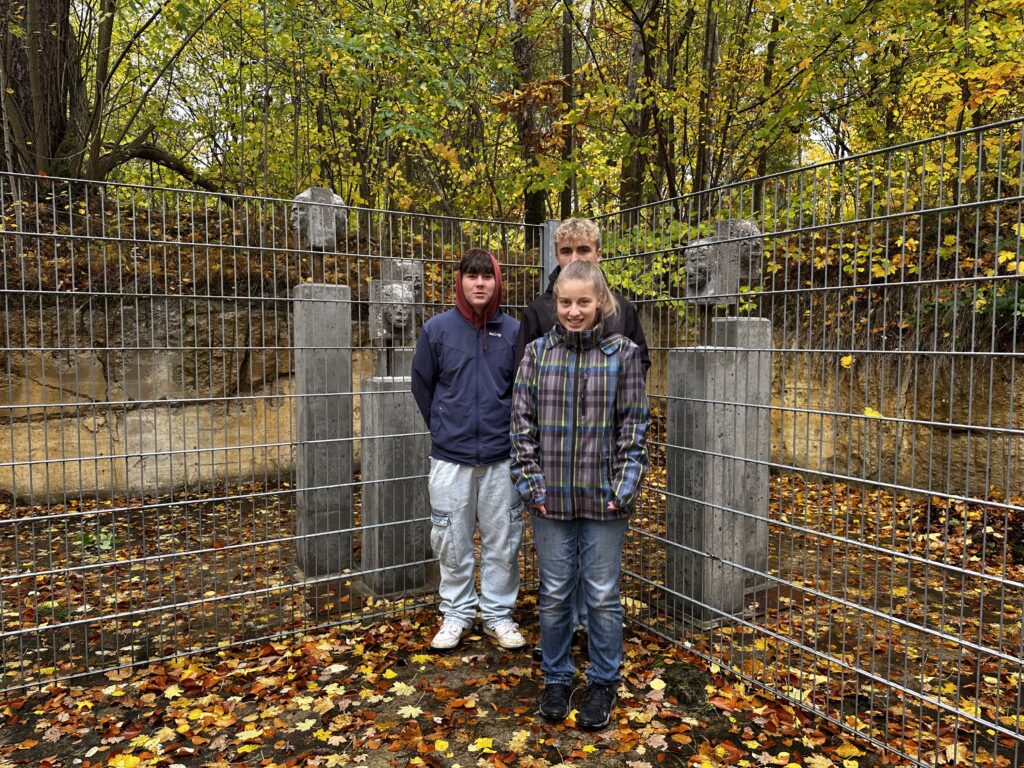
"In the face" - reliefs made of clay

The clay reliefs from the year 2025 were created as part of the Path of Remembrance project and depict the faces of former prisoners of Subcamp S III. After an examination of local history and biographical research, the pupils modelled portrait fragments that make the unspeakable visible: pain, exhaustion, dehumanization – but also humanity, presence and dignity.

While working on the clay, the young people not only formed external features, but also dealt intensively with individual fates. In every relief you meet a person whose history was almost wiped out. The abstract, sometimes rough depiction, the traces of the hands in the material and the reduced formal language create an atmosphere of closeness without exceeding the limits of what can be depicted.

The fired clay works are deliberately designed as wall reliefs. They can be presented indoors – for example in Ehrenstein Castle, in the documentation center or in the protected entrance area of Muna Crawinkel – and thus expand the path of remembrance with places of quiet, concentrated encounters.

“Im Angesicht” describes this moment of confrontation: you look at a face that seems to speak from the past – and at the same time you see your own responsibility in the present.

Historical background

During the Second World War, the SS had an underground munitions factory built near Crawinkel. Concentration camp prisoners were forced to work under inhumane conditions, many of whom did not survive. Today, the complex stands as a silent witness to the crimes of the Nazi era.

Biographies of former prisoners

Zoltan Mandel

Zoltan Mandel was registered in camp S III in 1945; nothing is known about his further fate.
Zoltan Mandel (1925-unknown)

Zoltan Mandel was born on March 25, 1925 and came from Hungary of Jewish origin. He learned the trade of shoemaker.

During the National Socialist persecution, Mandel was initially sent to the Flossenbürg concentration camp, where he was given the prisoner number 33 836. He was later transferred to Buchenwald, where his prisoner number was 6,733. On January 15, 1945, he was registered in subcamp S III/ Ohrdruf, where he was given prisoner number 109 684 and housed in Block 23.

No further information is available on the whereabouts of Zoltan Mandel.

Michal Siemieciak

Michal Siemieciak was registered in camp S III in 1945 and died there on January 27, 1945.
Michal Siemieciak (1902-1945)

Michal Siemieciak was born on November 18, 1902 in Czerlona, Russia. He was registered under prisoner number 110924 in Buchenwald Subcamp S III and was admitted to the HKP on January 12, 1945, where he was diagnosed with phlegmon of the left forearm. He received treatment and was again transferred to Subcamp S III on January 15, 1945. Michal died on January 27, 1945 at 2 a.m. in Ohrdruf Subcamp. The presumed cause of death was sepsis as a result of phlegmon, combined with acute cardiac insufficiency. His death is recorded on page 159 of the 1945 Buchenwald Book of Death.

Josef Sichermann

Josef Sichermann was committed to Camp S III in 1945; his further fate remains unknown.
Josef Sichermann (1910-unknown)

Josef Sichermann, born on March 15, 1910 in Hungary, was a political prisoner who was deported to the Buchenwald concentration camp system during the last months of the war. He belonged to the group of Hungarian Jews who were systematically disenfranchised, persecuted and deported to camps after the invasion of the German Wehrmacht.

On January 15, 1945, he was sent to the S III / Ohrdruf satellite camp, where he was given the prisoner number 110918. His documents subsequently record his transfer to the “Kl. Pon. 2” is noted in his documents. The designation “Pon. 2” denotes a special commando that was deployed as part of the secret underground construction work for the S III project.

There is as yet no reliable information about his fate.

Jan Siedochowicz

Jan Siedochowicz was committed to Camp S III in 1945; nothing is known about his further fate.
Jan Siedochowicz (1923-unknown)

Jan Siedochowicz was born in Poland on September 10, 1923. On January 15, 1945, he was sent to the S III / Ohrdruf satellite camp of Buchenwald concentration camp, where he was given the prisoner number 110923.

In the documents, the work detachment “Kl. Pon. 2” – a construction section commando within the S-III complex, which was presumably deployed as part of the underground construction work.

Further information on his fate after these entries has not yet been documented.

Jan Majchrzak

Jan Majchrzak was taken to Camp S III in 1944 and died there in the same year.
Jan Majchrzak (1922-1944)

Jan Majchrzak was born on December 22, 1922 in Ober Dädersdorf. He came from a Catholic family of Polish origin and learned the trade of shoemaker. Majchrzak led a blameless life without a criminal record. The Stuttgart state police ordered his protective custody as early as September 5, 1944.

He was arrested in Oberndorf on October 4, 1944 and sent to Dachau concentration camp on November 23, 1944, where he was listed as a political prisoner and given the prisoner number 131 513. Shortly afterwards, on December 5, 1944, he was transferred to Buchenwald and registered there under the number 100 925. On December 13, 1944, he was transferred to subcamp S III, where his prisoner number was 109 654.

Jan Majchrzak was 1.72 m tall, had dark blond hair, an elongated face, blue eyes, seven missing teeth and an overall weak physical condition. He was placed in block 23.

On December 29, 1944, he was admitted to the HKB after falling ill with pneumonia. Jan Majchrzak died on the same day, presumably of cardiomyopathy. His short life and his suffering as a political prisoner bear witness to the hardship and cruelty of the time.

Aleksander Drabiuk

Aleksander Drabiuk, born in 1921, was transferred to Camp S III in 1944 and is considered to have escaped from February 1945.
Aleksander Drabiuk (1921-unknown)

Aleksander Drabiuk was a Protestant Pole born on August 28, 1921 in Ruda near Chełm. His parents were Teodor and Tatjana Drabiuk.

He worked as a merchant, locksmith, security guard and carpenter and spoke Ukrainian, Polish and German. He served in the Waffen SS from 1943 to 1944. On April 28, 1944, he was arrested in the Träwniki SS training camp and sent to Auschwitz on May 10, 1944. Drabiuk was 1.63 m tall, of medium build, had dark brown hair, brown eyes, an elongated face, large protruding ears, a small mouth, a straight, long nose, no beard and missing teeth.
On December 7, 1944, he was sent to Buchenwald with prisoner number 28874 and on December 13, 1944, he was transferred to subcamp S III/ Ohrdruf with the number 107438. His name, date of birth and prisoner number can also be found in a card index from Leitmeritz, but this cannot be dated; his profession as a cook is noted there. He was considered a fugitive from February 21, 1945. There is no further information on Drabiuk. He was therefore probably one of the few prisoners who successfully escaped.

Gallery